+11.87pp · 10/10 seeds
10 seeds × 300 tasks · Pre-registered · CI computed
Summary
On Qwen3.5-9B across ten seeds x 300 tasks per seed, a Growing arm with scope-matched, success-gated retrieval lands at 97.33% — against 85.40% for Empty context. That is a +11.87 percentage-point lift, all 10 seeds positive, exact sign-test p = 0.00195.
Two ablations now place that lift on a real scale:
- Token count alone (Arm C — matched-token random prior successes) produces ~ 0pp; it lands at 84.93%, statistically indistinguishable from Empty.
- Scope-matched content with the deposit schema stripped (Arm D — same retrieved trajectories, flattened to plain text under an "examples" key) lands at 96.70%. This is ~94% of the total lift, recovered without the deposit JSON structure or the "field" namespace.
- Deposit schema and namespace add a smaller, reproducible +0.70pp on top (Growing minus Arm D, 95% CI [+0.60, +0.80], sign-test p = 0.00195, 10/10 seeds positive). A renderer-invariance falsifier across three byte-different separators (space, newline, pipe) holds the gap inside a 0.11pp band — so it is not a serialization artifact.
The decomposition. Of the 12-point lift, scope-matched retrieval contributes about 94%; the structured deposit format contributes about 6%. The big lever is finding the right prior outcomes for the current task. The small lever is presenting them inside the trained memory-namespace rather than as generic in-context examples.
__What this is not.__ A test against frontier models, a third independent domain, or a portability-at-scale claim. Each of those is queued separately. This post is one mechanism question, asked carefully, and one answer in two slices.
What the field is
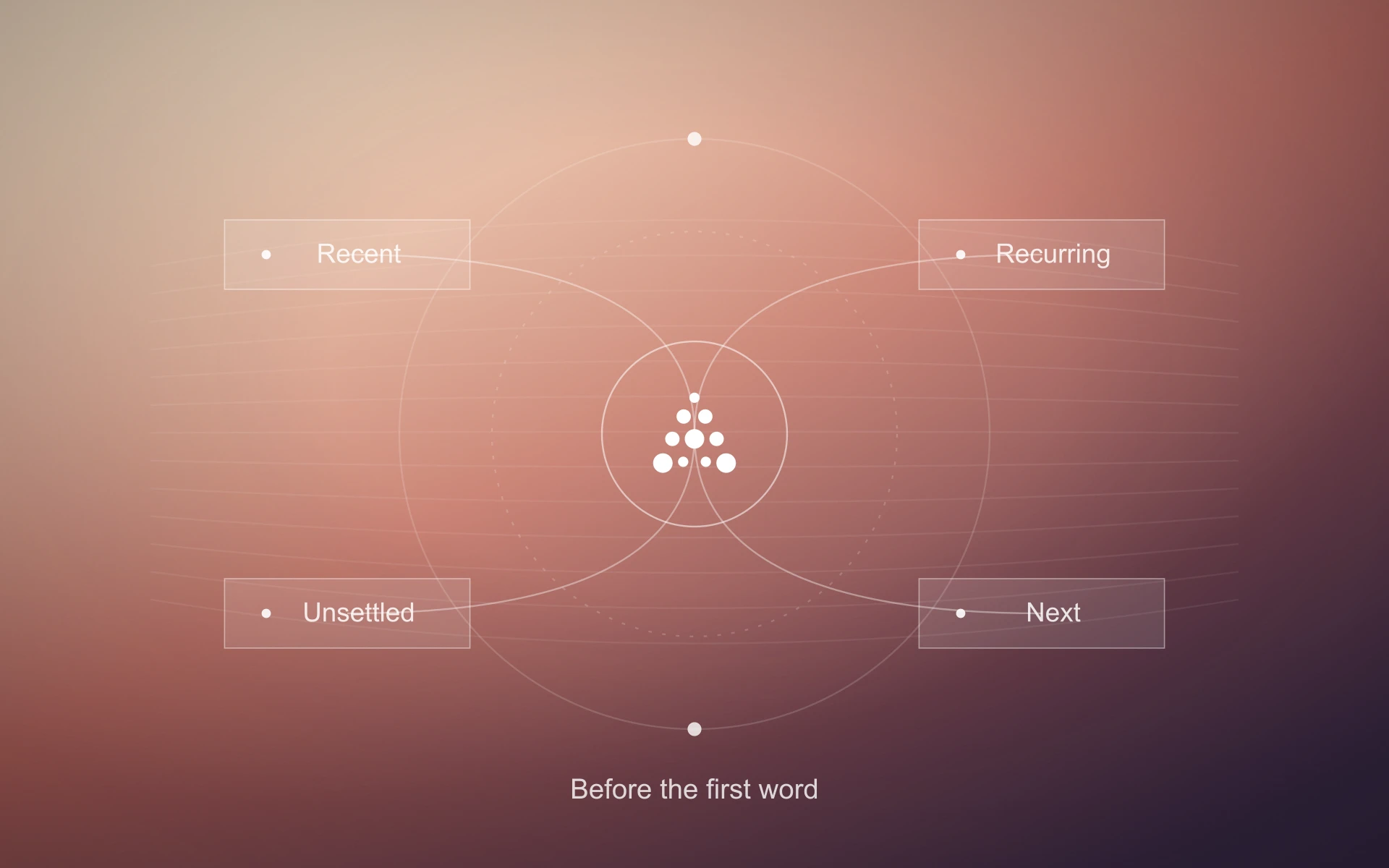
The memory field is a shared, append-only store that every agent reads from and writes to. After each task an agent finishes cleanly, the substrate synthesizes a short structured summary — which building was visited, which approach worked, which didn't — and deposits it. Future agents solving nearby tasks retrieve the most relevant prior deposits before they decide. The field is not a vector of latent numbers; it's human-legible text. You could read any entry and know exactly what the agent learned and when.
The 10-seed result
Setup
We ran a longitudinal delivery simulation — 300 adversarial navigation tasks per seed, delivered one at a time, with a growing memory field that accumulates across the run. The agent is a fine-tuned 9B model (Qwen3.5-9B base, our V3 fine-tune, bf16 precision via vLLM). We compared two arms on the same 300 tasks: empty (no field) and growing (field + deposits written after each clean win). We repeated this for seeds 1 through 10 — 10 full replications, 6,000 task runs total. Wall-clock: about 2 hours 17 minutes on a Colab G4 Blackwell GPU.
Per-seed table
| Seed | Empty | Growing | Lift | Deposits |
|---|---|---|---|---|
| 1 | 0.8500 | 0.9767 | +12.67pp | 224 |
| 2 | 0.8567 | 0.9700 | +11.33pp | 224 |
| 3 | 0.8567 | 0.9700 | +11.33pp | 224 |
| 4 | 0.8567 | 0.9700 | +11.33pp | 224 |
| 5 | 0.8567 | 0.9700 | +11.33pp | 224 |
| 6 | 0.8567 | 0.9700 | +11.33pp | 224 |
| 7 | 0.8533 | 0.9733 | +12.00pp | 226 |
| 8 | 0.8533 | 0.9800 | +12.67pp | 227 |
| 9 | 0.8533 | 0.9767 | +12.34pp | 224 |
| 10 | 0.8533 | 0.9767 | +12.34pp | 224 |
Table 1: Per-seed final success rates across 300 tasks. 6 of 10 seeds land at exactly +11.33pp because 34/300 = 0.1133 is the granularity floor near the near-ceiling success rates — not a sign of fabrication.
Aggregates - Empty arm: 85.4% mean (stable 85.00–85.67% across 10 seeds) - Arm C — matched-token random-success ICL: 84.93% mean. Indistinguishable from Empty. Token-count effect alone: ~0pp. - Arm D — scope-matched, schema stripped: 96.70% mean across 10 seeds. Recovers ~94% of the total lift with no deposit JSON structure and no "field" namespace. Renderer-invariance check across three byte-different separators holds the Growing minus Arm-D gap inside a 0.11pp band — so the structured contribution is not a serialization artifact. - Growing arm: 97.33% mean (stable 97.00–98.00% across 10 seeds) - Growing minus Empty: +11.87pp (95% CI [+11.53, +12.24], paired-seed bootstrap; 10/10 positive; sign-test p = 0.00195) - Growing minus Arm C: +12.40pp (95% CI [+12.13, +12.67]; 10/10 positive; sign-test p = 0.00195) - Growing minus Arm D: +0.70pp (95% CI [+0.60, +0.80]; 10/10 positive; sign-test p = 0.00195). Renderer-invariance: per-renderer mean spread 0.11pp — gap reproduces across serializations. - Decomposition. Token count: ~0% · Scope-matched retrieval + content: ~94% · Deposit schema/namespace: ~6%.
Interpretation
Every seed shows the lift. The tightness is unusual for a stochastic LLM-agent workload: the growing-arm success rate falls inside a 1pp band across 10 independent runs. This is the mechanism asserting itself consistently — not a single-seed anomaly that would dissolve on replication. The empty-arm ceiling at 85% tells us the 9B model is already quite good at the core task; the growing field is closing most of the remaining gap to 100%, not creating competence from scratch.
The second pilot — trading data
In a separate pilot, we ran the same field mechanism on a real dataset: 500 trades sampled from a 3.5-year, 8,434-trade book. Each trade's context (symbol, direction, session, day, hour, recent streak) was fed to a binary profitable / not-profitable classifier, with the option to seed the classifier with accumulated outcomes from prior similar trades. A GPT-5.4 frontier model alone hit 43.8% accuracy. The same frontier model with an accumulating field of 500 prior outcomes hit 58.4% — a +14.6 percentage-point lift. Our local 9B went from 40.2% to 44.2% under the same treatment (+4pp). This is a single-run pilot, not a benchmark; the result says the mechanism carries signal on real data, not that we've built a trading system.
Portability — the most distinctive finding
A 4-billion-parameter model — smaller and weaker than the 9B — was run on a held-out task set with no field, scoring 26%. We then seeded its field with 38 deposits that the 9B had written during its own deployment on a different set of tasks. The 4B's success rate jumped to 66% — a +40 percentage-point lift from deposits written by a different, larger model. Those 38 deposits beat 200 hand-curated synthetic deposits at matched field size (66% vs 62%). Memory written by one model transferred to another, and agent-curated experience turned out to be denser per entry than enumerated rules. This is the finding we're most curious to see hold up across more model pairs; the one test does not a law make.
What we have NOT done
- Tested whether the 6% deposit-format effect is itself a trained behavior of this fine-tune. The V3 model was trained on substrate-V04 data where retrieved content sits under a "field" key. The +0.70pp gap we measure could be the model behaving as trained rather than a generic property of structured deposits. A second-fine-tune ablation, or testing a base-model variant, would address this.
- Direct frontier comparison on identical task instances. Our frontier comparisons so far mix different seeds, different task-set sizes, and different scoring windows. A clean head-to-head on the same 300 tasks per seed, same ordering, same scoring is pending.
- Third longitudinal domain at full scale. The 10-seed result is one domain (delivery). The trading pilot is a single small run. A third independent long-horizon domain would close the "domain-specific artifact" objection.
- Ablations on the portability claim. We have one model pair (9B writes to 4B reads), one task set, and one deposit subset. Multiple pairs and randomized deposit subsets would make the portability claim more than a single data point.
Mechanism
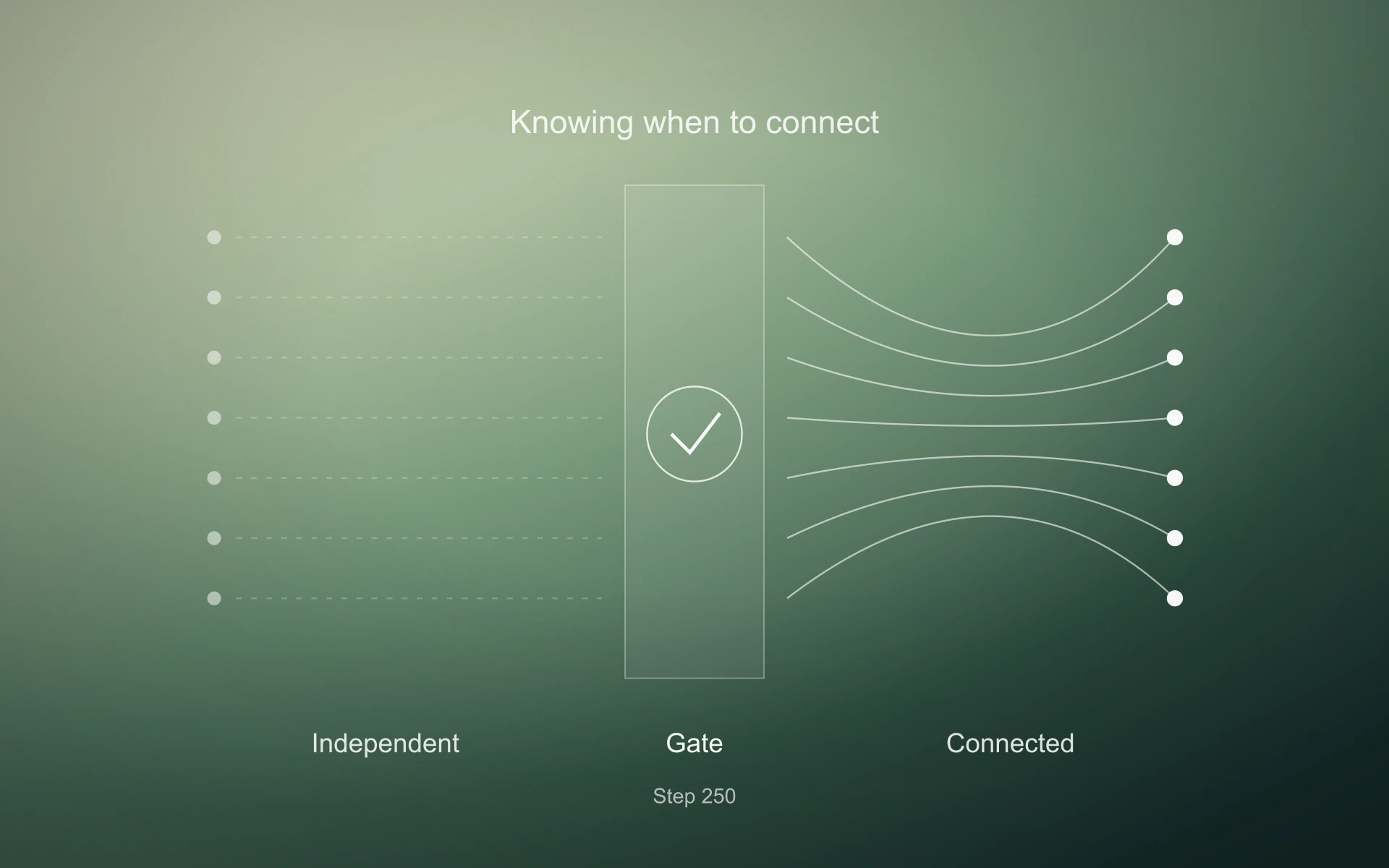
The field substrate has four permanent design choices that had to be right for the memory loop to work at all. (1) A strict-4-axis retriever that only surfaces deposits matching the current task's building family, direction, session, and recent-streak context. (2) Success-gated deterministic deposit synthesis — only clean wins (success AND cost-ratio <= 1.2) produce a deposit, and the deposit content is deterministically derived from the step history, not free-form. (3) Sequential-within-seed task ordering — task N+1's retrieval happens after task N's deposit is written, not at the same batch step. (4) Cross-seed batched inference for throughput, with per-request seeds to preserve determinism. A bit-identical parity check against a trusted sequential reference (HF seed 1: 0.9700 = 0.9700, 297/300 action match) is what made this result trustable.
What's next
- Frontier head-to-head on identical task instances. Same 300 tasks, same ordering, same scoring. Until we run this, we cannot compare 9B+field to a frontier model in a way that survives review.
- Full factorial attribution sweep. Content-identity x position x scope, ~30 hours on a G4. The gate to the strongest mechanism claims. Useful for the preprint, not the blog.
- Multi-pair portability. Re-run the 9B to 4B transfer with additional source/target model pairs and randomized deposit subsets. Needed before the portability figure becomes a real claim rather than one data point.
- Third domain. Delivery and trading are two. A third independent long-horizon domain at full scale would make the mechanism claim much harder to dismiss as a simulator artifact.
Summary
The 12-point lift on Qwen3.5-9B is real, replicates across ten seeds, and decomposes cleanly: about 94% comes from scope-matched retrieval finding the right prior outcomes for the current task, and about 6% comes from presenting them in the trained deposit structure rather than as generic in-context examples. The 6% slice is small but reproducible — it survives three byte-different serializations of the same retrieved content. The big lever is retrieval. The small lever is format. We have not run the frontier head-to-head, the third domain, or the full attribution factorial — those are queued. This is one honest mechanism question, asked in two slices.